

The quality of a finished powder supplement is determined long before it reaches a consumer's shaker bottle. It is determined during blending, the production phase where individual ingredients are combined into a uniform, functional mixture. Powder blending is not a mechanical step that happens between formulation and packaging.
It is the phase where formula design meets manufacturing reality, and where the decisions made about equipment, sequence, parameters, and validation either produce a consistent, high-quality product or reveal the gaps that prevent one.
What Powder Blending Actually Achieves
Blending combines multiple ingredients with different physical properties into a mixture where each component is evenly distributed throughout the batch. That distribution is what ensures every serving contains the same ingredient profile at the same concentrations. A blend where active ingredients are unevenly distributed produces a batch with unpredictable potency from serving to serving.
Achieving uniform distribution is not automatic. Ingredients with different particle sizes, bulk densities, and surface characteristics resist mixing in different ways. Some tend to segregate by density during blending, settling into layers that undo the work of mixing. Others clump together and resist dispersion even under prolonged blending. Still others carry electrostatic charges that cause them to adhere to equipment surfaces rather than distributing through the blend.
A well-executed powder blending process accounts for these properties before blending begins. Ingredient characterization, informed equipment selection, and validated blending parameters are what allow a manufacturing team to predict and manage how a specific formula will behave under specific blending conditions.
Equipment Selection and Its Effect on Blend Quality
Blending equipment is not interchangeable across formulas. Different blender designs produce different mixing dynamics, and the design best suited to a specific formula depends on the physical properties of the ingredients being combined. A blender optimized for dense, free-flowing powders may produce poor results with a formula containing light, cohesive ingredients that require gentler mixing action.
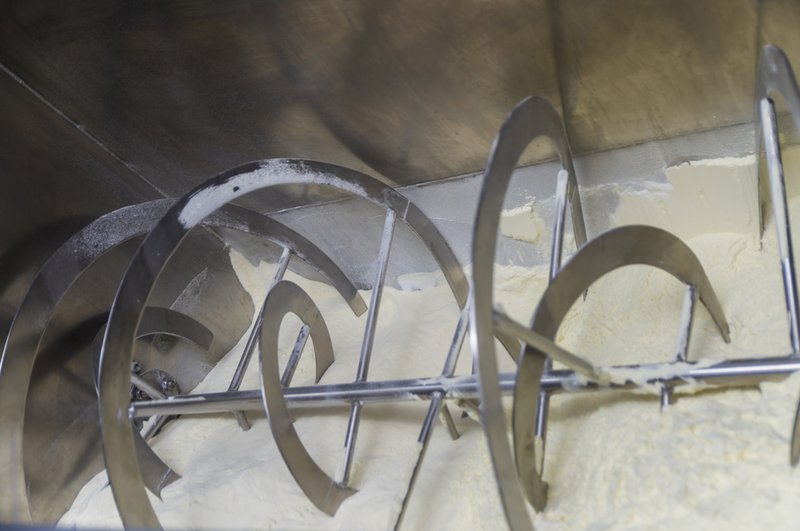
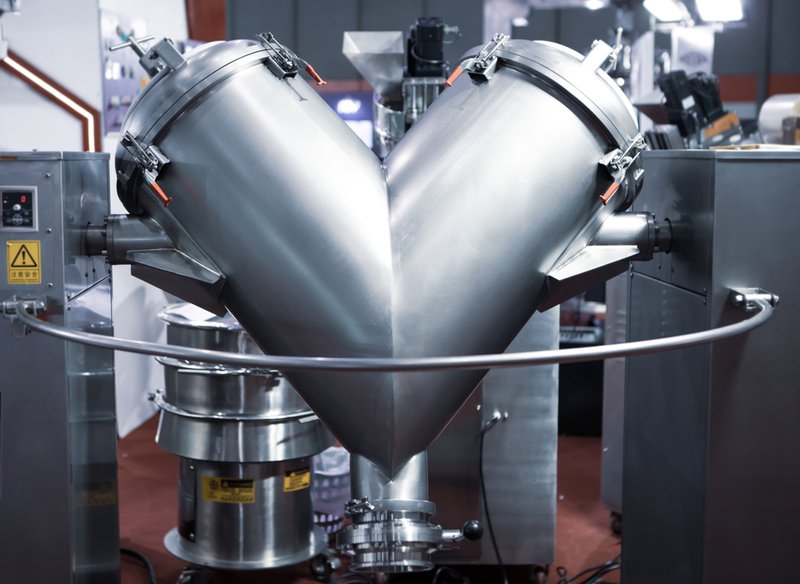
The most common blender types in supplement powder production include V-blenders, bin blenders, and ribbon blenders. Each has specific applications where it performs well and formulas where it does not:
- V-blenders produce tumbling and diffusive mixing suited to free-flowing powders with similar particle characteristics.
- Ribbon blenders use mechanical agitation that can handle more cohesive blends but may introduce heat or shear that damages sensitive ingredients.
- Bin blenders offer the advantage of blending in the same container used for transfer, reducing the cross-contamination and segregation risks that come with inter-vessel transfers.
Matching blender type to formula characteristics is a formulation and process engineering decision. It requires knowledge of how the specific ingredients in a formula behave mechanically, not just what they do biochemically.
Blending Parameters and Why They Must Be Validated
Speed, time, and fill level are the three primary parameters that govern how a blender operates during a production run. Each has a meaningful effect on blend quality, and the optimal values for each are specific to the formula being blended, not universal across all products running on the same equipment.
Blending too slowly or for too short a time produces a poorly mixed batch with uneven ingredient distribution. Blending too aggressively or for too long can cause segregation, where ingredients that were initially well-mixed begin to separate by size or density under continued mechanical action. The optimal blending window sits between those failure modes, and finding it requires validation work rather than assumption.
Fill level is a parameter that many brands and even some manufacturers overlook. A blender filled to a level significantly above or below its validated range does not mix the same way as one operating within that range. Overfilling reduces the headspace needed for tumbling action. Underfilling changes the mechanical dynamics of ingredient interaction. Both conditions can compromise blend uniformity even when speed and time are correctly set.
Ingredient Addition Sequence in Powder Blending
The order in which ingredients are added to a blender affects how well they distribute through the final blend. This is particularly important for low-dose active ingredients, colorants, and flow agents that are present in small quantities relative to the total batch weight.
Adding a minor ingredient to a blender that already contains a large volume of bulk material can result in that ingredient becoming trapped in a localized zone rather than distributing throughout the blend. A better approach is to use geometric dilution, gradually increasing the concentration of a minor ingredient by blending it first with a small portion of a major ingredient, then incorporating that premix into the broader batch. This technique dramatically improves distribution uniformity for low-inclusion ingredients.
Lubricants and flow agents such as magnesium stearate require particular attention to addition sequence and blending time. These ingredients coat particle surfaces and reduce friction, which is the desired effect. However, over-blending after lubricant addition can produce excessive coating that impairs disintegration and dissolution in finished products. Lubricant addition is typically one of the last steps in the blending sequence, followed by only a brief mixing period defined by validation data.
Blend Uniformity Testing as a Non-Negotiable Control
No blending process, regardless of how well it is designed and executed, should proceed to filling or packaging without analytical confirmation that uniformity has been achieved. Blend uniformity testing provides that confirmation by measuring the concentration of one or more marker ingredients in samples drawn from multiple locations within the blended batch.
The sampling protocol matters as much as the testing itself. Samples drawn only from the top or center of a blender do not represent the full batch. A statistically sound sampling plan draws from locations distributed throughout the blend, including positions most likely to show segregation if it has occurred. The results from those samples, evaluated against a defined acceptance criterion, determine whether the batch is ready to proceed.
Blend uniformity testing results become part of the batch record, creating a documented quality checkpoint between blending and filling. That documentation supports batch release decisions, regulatory review, and investigation of any finished product potency findings that fall outside specification. Without it, a manufacturing team has no documented evidence that blending achieved its objective before the batch was committed to packaging.
How Powder Blending Connects to the Consumer Experience
At Bactolac Pharmaceutical, powder blending is executed within validated process parameters using equipment matched to the specific characteristics of each formula we produce. Our in-house blend uniformity testing confirms distribution quality before every batch proceeds to filling, and our powder manufacturing capabilities are built around the technical precision that consistent blending requires.
Learn more about how our powder blending process supports consistent quality across every batch we produce. Call us at 1-833-215-2935 or fill out a contact form to connect with our team.