

Strong ideas help launch new supplement products, but operational alignment determines whether those products scale successfully. Supplement product development becomes far more efficient when formulation goals match real manufacturing capabilities from the beginning.
Many delays and reformulation issues happen because products are designed without considering production realities. Ingredient limitations, packaging constraints, flavor challenges, and equipment compatibility may create expensive adjustments later. Early coordination between development and manufacturing teams helps reduce these problems while supporting smoother product launches.
Why Supplement Product Development Requires Manufacturing Input
Product development decisions affect every stage of production. Ingredient selection, dosage targets, serving formats, and packaging choices all influence manufacturing complexity and scalability.
Some formulas may perform well during early concept work but become difficult to manufacture consistently at larger volumes. High ingredient loads, moisture-sensitive actives, or poor powder flow can create operational challenges during blending and packaging.
Experienced manufacturers often help identify these risks early. Production input during supplement product development helps improve efficiency while reducing avoidable reformulation delays.
Supplement Product Development Should Match Equipment Capabilities
Manufacturing equipment affects how products behave during production. Filling systems, blending equipment, packaging lines, and environmental controls all influence final product consistency. Some formulas require specialized handling because of particle size, ingredient density, or moisture sensitivity.
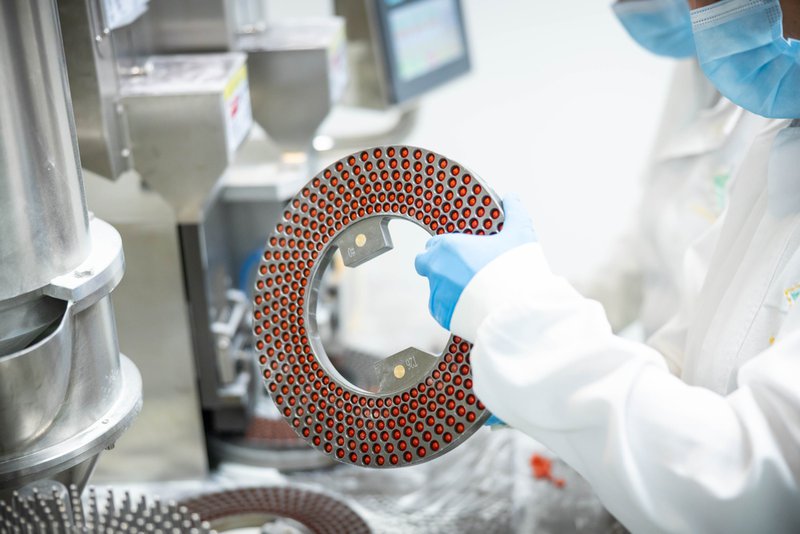
Products developed without considering equipment limitations may experience mixing inconsistencies or packaging inefficiencies later. Manufacturers with multiple production capabilities often provide greater flexibility during development. Better equipment alignment helps support smoother scaling and more reliable product performance.
Ingredient Selection Affects Supplement Product Development
Ingredient choice influences both formulation goals and operational performance. Some ingredients blend easily and remain stable throughout production. Others may create flavor, flowability, or moisture-control challenges.
Botanical extracts, probiotics, amino acids, and specialty actives often require additional production considerations. Solubility, particle behavior, and ingredient interaction may affect both manufacturing efficiency and customer experience.
Experienced development teams evaluate these factors together. Ingredient selection should support both product positioning and realistic manufacturing execution.
Flavor Systems Influence Product Manufacturing
Taste plays a major role in powder supplement success. Flavor systems must work alongside formulation goals while remaining compatible with large-scale production. Certain active ingredients create bitterness, metallic notes, or strong aftertastes. Flavor masking systems may require additional blending steps or specialized ingredient combinations during manufacturing.
Texture and mixability also matter. Powders that clump or disperse unevenly may reduce customer satisfaction even when formulas remain effective. Coordinating flavor development with manufacturing teams helps improve overall product consistency.
Packaging Strategy Should Support Supplement Product Development
Packaging decisions directly affect operational efficiency, shipping performance, and customer experience. Development teams should evaluate packaging compatibility early instead of treating it as a final production step.
Bulk tubs, stick packs, sachets, bottles, and gusset bags all require different filling systems and production workflows. Some formats may also create additional moisture-control or seal-integrity requirements.
Packaging strategy should align with both product positioning and manufacturing readiness. Early coordination helps prevent delays caused by incompatible packaging systems or material shortages.
Supplement Product Development Requires Scalability Planning
Products that perform well during pilot runs may behave differently at larger production volumes. Scaling introduces additional variables related to blending consistency, material handling, and production timing. Manufacturers with scaling experience often help development teams prepare for these changes earlier.
Production simulations, pilot testing, and equipment compatibility reviews can reduce operational surprises later. Scalability planning also affects inventory management and forecasting. Manufacturers should help brands evaluate realistic production capacity before launch demand increases.
In-House Testing Supports Better Development Outcomes
Testing plays an important role throughout supplement product development. Ingredient verification, microbial testing, stability analysis, and blend consistency all affect final product quality.
Manufacturers with in-house testing capabilities often provide faster development feedback. Shorter testing timelines help teams refine formulas more efficiently during active product development.
Testing also improves production confidence before scaling. Early quality validation helps reduce the risk of delays, rejected batches, or post-launch product inconsistencies.
Supplement Product Development Benefits from Integrated Operations
Fragmented production models may create communication gaps between formulation, testing, packaging, and manufacturing teams. These gaps often increase development delays and reduce operational visibility. Integrated manufacturing environments usually support faster collaboration throughout product development.
Formulation teams can work more closely with production and quality departments during active development cycles. This coordination helps reduce misalignment between product goals and manufacturing realities. Faster communication often improves both efficiency and final product consistency.
Regulatory Planning Affects Product Development Timelines
Compliance requirements influence ingredient usage, labeling, testing, and documentation throughout development. Delayed regulatory review can slow production schedules and create unexpected revisions later.
Manufacturers with regulatory experience often help brands prepare documentation earlier in the process. Better planning helps reduce launch delays related to labeling corrections or ingredient compliance concerns.
Documentation systems also support long-term scalability. Organized production records improve operational consistency as product lines expand.
Supplement Product Development Should Include Supply Chain Planning
Ingredient availability can change quickly across supplement categories. Supply disruptions, transportation delays, and shifting lead times may affect production schedules unexpectedly.
Development teams should evaluate sourcing stability before finalizing formulas. Ingredients with limited availability may create operational risks during future scaling periods.
Manufacturers with broader supplier networks often provide greater sourcing flexibility. Better supply chain planning helps reduce future reformulation pressure and production interruptions.
Operational Alignment Improves Long-Term Product Performance
Many product issues originate from weak coordination between development and manufacturing systems. Products designed without operational alignment may face avoidable delays, quality inconsistencies, or packaging challenges later.
Supplement product development becomes more efficient when manufacturing capabilities are considered throughout formulation, testing, packaging, and scaling decisions. Early collaboration helps improve production consistency while supporting long-term growth.
At Bactolac Pharmaceuticals, we support brands through integrated supplement manufacturing, in-house testing, advanced flavor system development, and turnkey packaging capabilities across powders, capsules, tablets, stick packs, sachets, bottles, and more. Our team works closely with brands to align product development goals with scalable manufacturing execution.
Contact us or call 1-833-215-2935 to connect with our team.